
Complete Guide to Choosing Industrial Cleaners: How to Match the Best Cleaning Solution for Your Equipment
Whether it is the maintenance of equipment or the cleanliness of the industrial plant environment, the choice of cleaning agent is directly related to the operational efficiency of the production line. If the selection is inappropriate, it can result in reduced equipment efficiency at best, or at worst, affect the entire factory’s production environment and safety standards.
Faced with the vast differences in production processes and cleaning objects, how can one use a ‘keen eye’ to select the most suitable product from among many options? This requires comprehensive consideration from three core dimensions: cleaning method, type of medium, and anti-rust requirements.
Cleaning Method: The Struggle Between Ultrasonic and Spray Cleaning
The working principle of cleaning equipment determines the physical form requirements of the cleaning agent. Currently, the mainstream cleaning methods are mainly divided into ultrasonic cleaning and spray cleaning, and the two have completely different requirements for the foaming properties of cleaning agents.
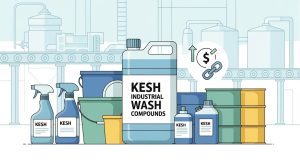
Spray Cleaning: The spray cleaning machines used by enterprises currently typically operate at pressures between 3-20KG. This high-pressure environment requires the cleaning agent to have a ‘low-foam’ characteristic; otherwise, excessive foam can hinder the liquid impact and even cause the pump to run dry. However, low-foam formulations often mean restrictions on certain high-efficiency surfactants, which to some extent may weaken the ability to degrease. Therefore, choosing a low-foam degreasing agent developed by companies like KESH Chemical is key to balancing cleaning power through technical formulation while ensuring low-foam performance.
Ultrasonic Cleaning: In contrast, ultrasonic cleaning uses the cavitation effect to remove dirt and is less sensitive to foam. In this scenario, high-foam or medium-foam cleaning agents with stronger detergent power can be prioritized to maximize cleaning effectiveness.
Medium Selection: Balancing Water-Based and Solvent-Based Options
The choice of cleaning medium determines the cost, evaporation speed, and safety of the cleaning process.
Water-Based Cleaners: If a company is sensitive to cost control and has no special requirements for post-cleaning evaporation speed, water-based cleaners are the preferred choice. For example, Shenzhen KESH Technology Co., Ltd., as a national high-tech enterprise, focuses on environmentally friendly fine chemicals. Its water-based cleaners are not only cost-effective but also align with environmental trends, widely used in hardware manufacturing and the optoelectronics industry.
Solvent-Based Cleaners: When rapid evaporation is required, and no water residue can be left on the cleaned objects, solvent-based cleaners demonstrate their unique advantages. These products generally have very strong degreasing capabilities, suitable for the rapid cleaning of precision parts.
Rust Prevention Needs: Balancing Cleaning and Protection
Cleaning is not just about removing dirt; it is also a ‘reshaping’ of the metal surface.
Importance of Rust Prevention: In production processes, water-based cleaners are widely used due to their low cost. However, ordinary water-based cleaners, while removing grease, may also strip the protective layer from the metal surface. Without rust-preventive properties, workpieces are prone to quickly rust after cleaning.
Functional Choice: If the process has explicit rust-prevention requirements, water-based cleaners with rust-inhibiting additives must be selected. Through technical cooperation with the Chinese Academy of Sciences and major universities, KESH Chemical’s product line includes rust inhibitors and cleaners with excellent corrosion protection effects. These products can form a protective film on the metal surface while cleaning. Although adding rust-prevention components may slightly adjust the chemical balance of the cleaner, KESH effectively resolves the balance between rust prevention and cleaning efficiency through the R&D principles of ‘specialized, refined, deep, stable, and innovative.’
Professional Brands Help Upgrade Industrial Cleaning
Choosing industrial cleaners is not simply about ‘removing dirt’; it is a systematic project involving physics, chemistry, and engineering. From matching spray pressure to implementing rust-prevention processes, every step requires precise control.
As a leading domestic brand in industrial environmentally friendly cleaners, Shenzhen KESH Technology Co., Ltd. has been deeply engaged in the industry for over twenty years, not only providing standardized cleaning solutions but also offering customized services for different industries such as LCD, optical glass, and precision hardware. Choosing KESH means not just choosing a cleaner but also a professional partner who can assist in optimizing production processes and improving product yield.