Introduction
Aluminium components are widely used in modern manufacturing because of their lightweight structure, excellent machinability, and attractive surface appearance. However, machining and manufacturing processes inevitably leave oils, lubricants, and processing residues on aluminium surfaces.
For manufacturers, effective oil removal is not simply a cleaning task. It is an important part of surface preparation, quality control, and production efficiency.
Professional aluminium oil removers can help remove machining oils and other contaminants before coating, anodising, bonding, assembly, or final inspection.
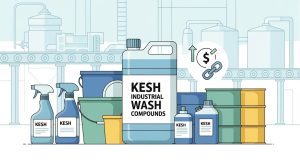
KESH develops industrial cleaning solutions for manufacturers that need reliable and consistent aluminium cleaning performance.
Where Does Oil Come From?
Aluminium parts may become contaminated with oil at different stages of production.
CNC Machining
CNC machining commonly uses lubricants and cutting fluids to reduce friction and heat. After machining, an oil film may remain on the finished component.
Stamping and Forming
Metal forming operations can require lubricating products to reduce friction between tools and aluminium materials.
Polishing
Polishing and finishing processes may introduce oily residues together with fine abrasive particles.
Assembly
Grease and lubricants used during assembly can transfer onto aluminium surfaces.
Equipment Contact
Oil from production machinery can also contaminate otherwise clean components.
Why Oil Removal Is Important
Leaving oil on aluminium can create problems during subsequent manufacturing stages.
Coating
Paint and powder coatings require properly prepared surfaces. Oil contamination can interfere with coating adhesion and create surface defects.
Anodising
Consistent surface preparation is important for achieving uniform anodised finishes.
Adhesive Bonding
Oil can reduce contact between the adhesive and aluminium surface.
Welding
Surface contaminants may negatively affect welding processes.
Final Appearance
Oil films can create visible marks, uneven gloss, or fingerprints on finished products.
Effective oil removal helps manufacturers establish a cleaner and more stable production process.
How Aluminium Oil Removers Work
Industrial oil removers generally work through a combination of chemical and physical mechanisms.
A suitable formulation can help:
- Wet the contaminated aluminium surface.
- Penetrate the oil film.
- Break down or emulsify the oil.
- Lift contaminants from the metal.
- Allow the residue to be removed during rinsing.
The exact cleaning process depends on the type of oil, contamination level, temperature, concentration, and equipment used.
Selecting an Aluminium Oil Remover
Not every industrial cleaner is suitable for every aluminium application.
Manufacturers should evaluate several factors.
Type of Contamination
Light machining oil may require a different cleaning approach from heavy industrial lubricant.
Surface Condition
Polished, anodised, cast, and machined aluminium may have different cleaning requirements.
Cleaning Equipment
The cleaner should be compatible with the available process.
Common methods include:
- Spray cleaning
- Immersion cleaning
- Ultrasonic cleaning
- Manual cleaning
Downstream Processing
Consider what happens after cleaning.
If the aluminium will be painted, anodised, bonded, or assembled, the cleaning process should be designed accordingly.
Spray Cleaning
Spray systems are particularly useful for high-volume production.
The combination of chemical cleaning and mechanical spray pressure can provide efficient removal of oil from exposed surfaces.
This method is commonly considered for:
- CNC-machined components
- Aluminium housings
- Automotive parts
- Precision hardware
- Industrial components
Automation can also improve process consistency and reduce manual handling.
Immersion Cleaning
Immersion cleaning provides direct contact between the aluminium component and the cleaning solution.
It can be useful for batch production and components with complex shapes.
Important process parameters include:
- Cleaning concentration
- Temperature
- Immersion time
- Agitation
- Rinsing
Proper process control helps achieve repeatable cleaning results.
Ultrasonic Cleaning
For small and complex aluminium components, ultrasonic cleaning can provide additional mechanical cleaning action.
It can help reach:
- Small cavities
- Narrow gaps
- Complex geometries
- Difficult-to-access surfaces
This makes ultrasonic cleaning particularly useful for precision manufacturing.
KESH: Industrial Cleaning Technology Since 2001
KESH has been engaged in industrial cleaning technology since 2001, building more than 25 years of experience in developing and manufacturing industrial cleaning solutions.
Our strength is not limited to product manufacturing. We combine formulation development, production capabilities, application knowledge, and customized services to support different industrial requirements.
Shenzhen and Zhuhai Manufacturing Bases
KESH operates production facilities in Shenzhen and Zhuhai, providing customers with stable manufacturing capacity and flexible supply support.
R&D Capability
Our technical team focuses on industrial environmental cleaning technologies and continuously develops solutions for changing manufacturing requirements.
OEM and ODM Services
KESH can support customers requiring:
- Customized formulations
- Private-label production
- Packaging customization
- Application-oriented product development
Industries We Support
Aluminium oil removal is relevant to many industries, including:
- Precision metalworking
- Automotive manufacturing
- Electronics
- Optical communications
- New energy
- Industrial equipment
- Electronic components
- Advanced manufacturing
As manufacturing becomes more automated and precise, consistent surface preparation becomes increasingly important.
How to Improve Aluminium Oil Removal
Manufacturers can improve cleaning efficiency by controlling the entire process rather than relying only on the cleaning chemical.
Consider:
1. Identify the contamination
Determine whether the primary contaminant is machining oil, grease, polishing residue, or a combination.
2. Select the appropriate cleaning method
Choose spray, immersion, ultrasonic, or manual cleaning according to production requirements.
3. Control concentration and temperature
Stable process conditions help maintain consistent performance.
4. Rinse properly
Rinsing removes loosened contaminants and cleaning residues.
5. Dry promptly
Proper drying helps prevent water spots and secondary contamination.
Frequently Asked Questions
What are aluminium oil removers used for?
They are used to remove machining oils, lubricants, grease, and other oil-based contaminants from aluminium components.
Can aluminium oil removers be used before coating?
Yes. Proper oil removal can help prepare aluminium surfaces for subsequent coating processes.
Can KESH customize aluminium cleaning solutions?
Yes. KESH provides OEM and ODM services and can develop industrial cleaning solutions according to specific manufacturing requirements.
Conclusion
Effective aluminium oil removers are an important part of modern aluminium manufacturing. Removing oil contamination properly can improve surface preparation, reduce production defects, and support downstream processes.
With more than 25 years of industrial cleaning experience, Shenzhen KESH Chemical Co., Ltd. combines R&D capabilities, manufacturing expertise, Shenzhen and Zhuhai production bases, and OEM/ODM services to provide customized industrial cleaning solutions for manufacturers worldwide.